

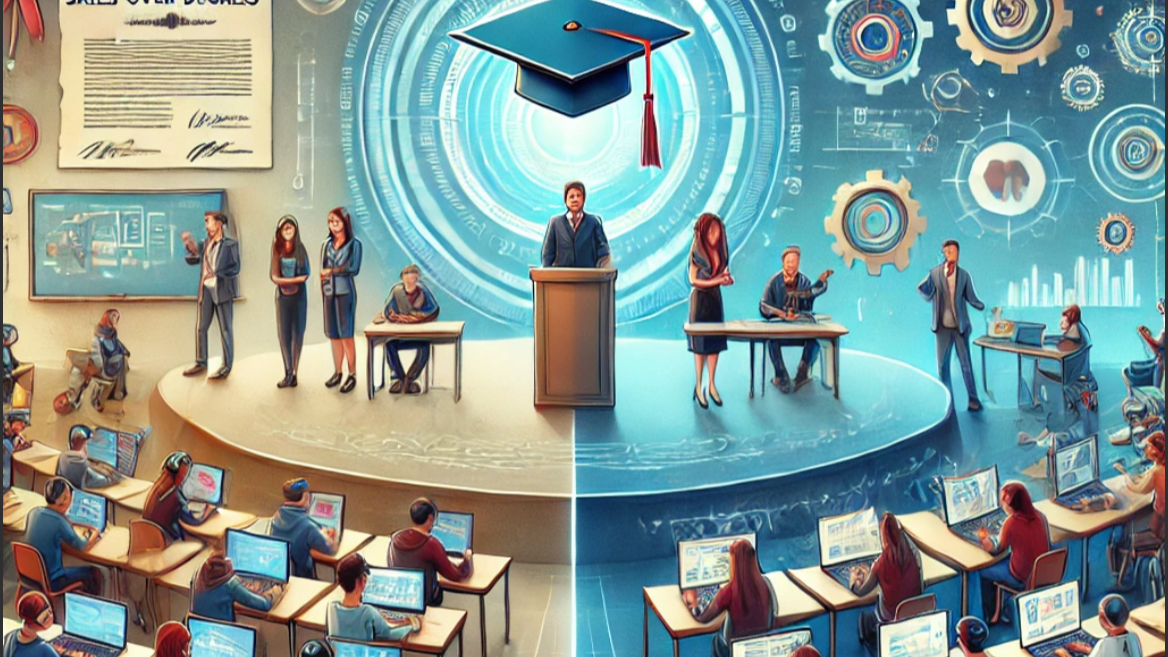



There was a time when the path felt almost pre-written. Study hard, get into a good college, earn a degree, land a stable job. Simple, predictable—at least on paper.
But somewhere along the way, that neat equation started to blur. Industries evolved faster than curriculums, companies began prioritizing what you can do over what you studied, and suddenly, the question got louder: what actually matters more—degrees or skills?
It’s not a debate with a clean answer. And maybe that’s what makes it interesting.
The Comfort of Traditional Degrees
Let’s start with degrees. They still carry weight—no denying that.
A university education offers structure. It gives you a foundation, exposure to different ideas, and, perhaps most importantly, credibility. In fields like medicine, law, or engineering, degrees aren’t just valuable—they’re essential.
There’s also something reassuring about a formal education. It signals commitment. It tells employers you’ve spent years learning, showing up, completing something that requires discipline.
But here’s the thing: the world doesn’t stand still.
By the time a four-year degree is completed, some of the skills learned at the start may already be outdated. That’s not a failure of education—it’s just the pace of change we’re living in.
The Rise of Skill-Based Learning
Now flip the lens.
Skill-based learning feels… faster. More direct. You learn what you need, when you need it. Online courses, bootcamps, self-learning platforms—they’ve opened doors that didn’t exist a decade ago.
You can become a designer, a coder, a marketer—sometimes without stepping into a classroom. It’s flexible, often more affordable, and aligned with real-world demands.
That’s why conversations around Skill-Based Learning vs Traditional Degrees: Future kya demand karega? are becoming more relevant, especially among younger professionals trying to make sense of their career paths.
Because the truth is, employers are changing too.
What Employers Are Actually Looking For
If you talk to hiring managers today, a pattern emerges.
They care about outcomes.
Can you solve problems?
Can you adapt?
Can you deliver results?
A degree might get your foot in the door, but skills are what keep you in the room.
Portfolios, real-world projects, hands-on experience—these are becoming powerful signals of capability. In some industries, they even outweigh formal qualifications.
But—and this matters—it’s not always an either-or situation.
The Middle Ground That Makes Sense
Here’s where things get nuanced.
Degrees provide depth. Skills provide agility.
When combined, they create something stronger. Someone with a solid academic foundation and practical skills often has an edge. They understand theory but can also apply it.
The challenge is that not everyone has access to both equally. And that’s where alternative learning paths are gaining traction.
People are finding ways to bridge the gap—learning online, building side projects, experimenting outside traditional systems.
The Pressure to Choose
There’s an unspoken pressure to pick one side.
Either you commit to a degree or you go all-in on skills. But real life rarely works that way. Careers aren’t linear anymore. People switch paths, learn new things, adapt as they go.
And maybe that’s the bigger shift.
The phrase Future kya demand karega? isn’t just about education—it’s about mindset. The future doesn’t demand a single qualification. It demands continuous learning.
That could mean updating your skills every few years. Or even completely reinventing yourself when needed.
Learning Doesn’t Really End Anymore
If there’s one takeaway from all this, it’s that learning is no longer a phase—it’s a constant.
Whether you start with a degree or jump straight into skill-building, you’ll eventually need both in some form. The difference lies in timing, access, and personal preference.
Some people thrive in structured environments. Others learn better by doing, failing, and figuring things out along the way.
Neither approach is wrong.
A More Personal Way Forward
What’s refreshing, though, is that people now have choices.
You’re not locked into a single path anymore. You can experiment, pivot, explore different interests without feeling like you’ve “wasted” time.
And that freedom—while sometimes overwhelming—is also empowering.
It allows you to define success on your own terms.
Final Thoughts
So, degrees or skills?
Maybe the better question is—what do you need right now?
Because the answer isn’t fixed. It evolves with your goals, your industry, and the kind of work you want to do.
In the end, the future isn’t choosing between degrees and skills. It’s quietly expecting you to keep learning, no matter where you start.